Drive down the 101 on a Thursday night at rush hour. I dare you.
Your wheels come to a standstill for minutes on end, leaving your eyes to wander farther than your car ever could. I’d been staring at the miles of traffic ahead of me for so long that it all began to blur.
But if you squint hard enough, and the sky is dark enough (and you’re just delirious enough), the cars begin to disappear — their brake lights bleeding into one another until it looks like someone spilled scarlet glitter across the pavement.

I didn’t mind my eyes playing tricks on me, though. If anything, I welcomed the distortion. It was a pleasant distraction from the monotony of the drive, and after a full day at work, a little levity was exactly what I needed.
Once a month, our product development team gathers for what we call a “line review” — a meeting where we examine new product samples, exchange ideas for our brands, and explore the latest innovations in the market.
The business of selling cookware and dinnerware might sound mundane, but the creative process is an exercise in imagination. Picture a corporate boardroom where my team and I debate the difference between cream and eggshell, all over a Dutch oven.
Colors are chosen, shapes are designed, glazes are debated (you’d be surprised how many opinions a frying pan can inspire) — every detail an opportunity to bring beauty to something otherwise ordinary.
Of course, not every brand allows for the same creative liberties. Who would have thought there were rules to creativity? There aren’t, really. But there are rules to brands, and some have more of them than others.
Take Martha Stewart, for instance. With all the pieces we create for her, we play in a world of vintage botanicals, classic forms, and timeless whiteware made for entertaining. Color remains calm and intentional — each piece rooted in a sense of tradition.
Oster, on the other hand, favors stainless steel, where shape and technology take precedence over the color of a pan.
And then there’s Bloomhouse.
Bloomhouse is my own brand developed under our company’s umbrella. Think vintage Ginori-inspired designs alongside vibrant speckled glazes. Terracotta paired with mango wood and whimsical scalloped silhouettes. Mediterranean patterns all bathed in sun-drenched color. Its visual language is still defined, but bolder, freer. (I’m still under the umbrella, of course, but I get to decide which way it tilts.)
“Our cookware is rounded, not straight-walled — inspired by Botero’s sculptures of the human form. Voluptuous and abundant. The colors we choose should mirror that,” I reminded everyone.
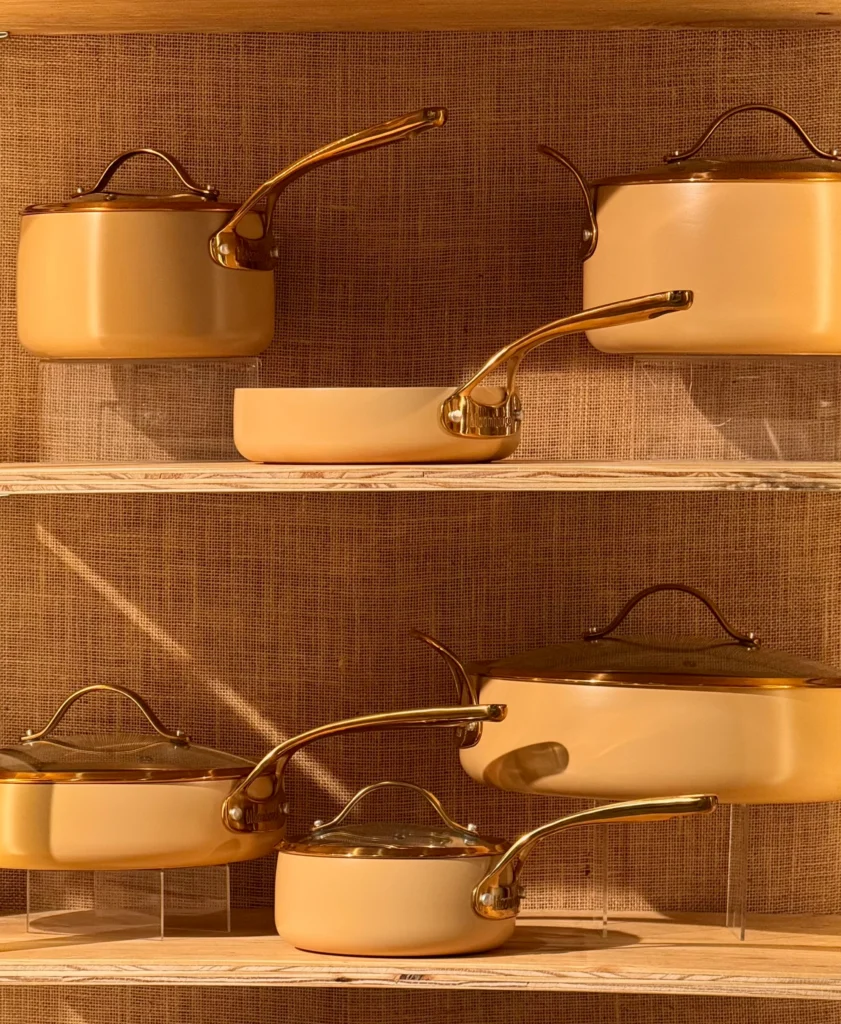
I held our newest piece, a stockpot with gleaming stainless steel handles. As it dangled from my fingertips, I found myself craving color along its curves.
“Honey,” I proclaimed. “Not yellow, not orange. Honey.”
Surrounded by shelves of taupe and grey, the team stared back at me for a moment — some amused, others confused.
“As in, a golden yellow with warm amber undertones,” I added, attempting to fill the silence.
“But would our customers buy cookware in that color?” one of my colleagues murmured skeptically. “How do we know it would sell?”
(Finally, some feedback.)
“Well, we don’t know how it would sell. It’s not in the line yet, and we’ve never produced cookware in this color before. But not every creative decision needs sales data to back it up. Let’s take a risk,” I urged them. “I think once it sits with the rest of the collection, it’ll make sense. Sometimes the things people don’t expect are exactly what excite them.”
There was some back and forth — a few more questions about the color, a few more concerns about who would buy it. Secretly, I had my doubts, too.
But between the skepticism and the sound of pens scribbling across notepads, heads began to nod. We agreed to make a sample and see where it took us.
(As much as I’d like to think we’re in the business of making beautiful things, we’re also in the business of selling them. But who knows — maybe a little honey would be enough to sweeten the deal.)
After an hour and a half of traffic, replaying bits of the meeting in my head, I finally pulled into my driveway.
Waiting by the front door sat a large brown cardboard box. Inside were 200 custom cups I’d ordered for a party I was throwing, each printed with the words “Just Because!”
Inside the house, dozens more boxes had congregated at the foot of the staircase, all waiting to be opened. I set down my bag and got to work, pulling apart packing tape and tearing through cardboard with conviction, as though the exhaustion of the commute had never happened.
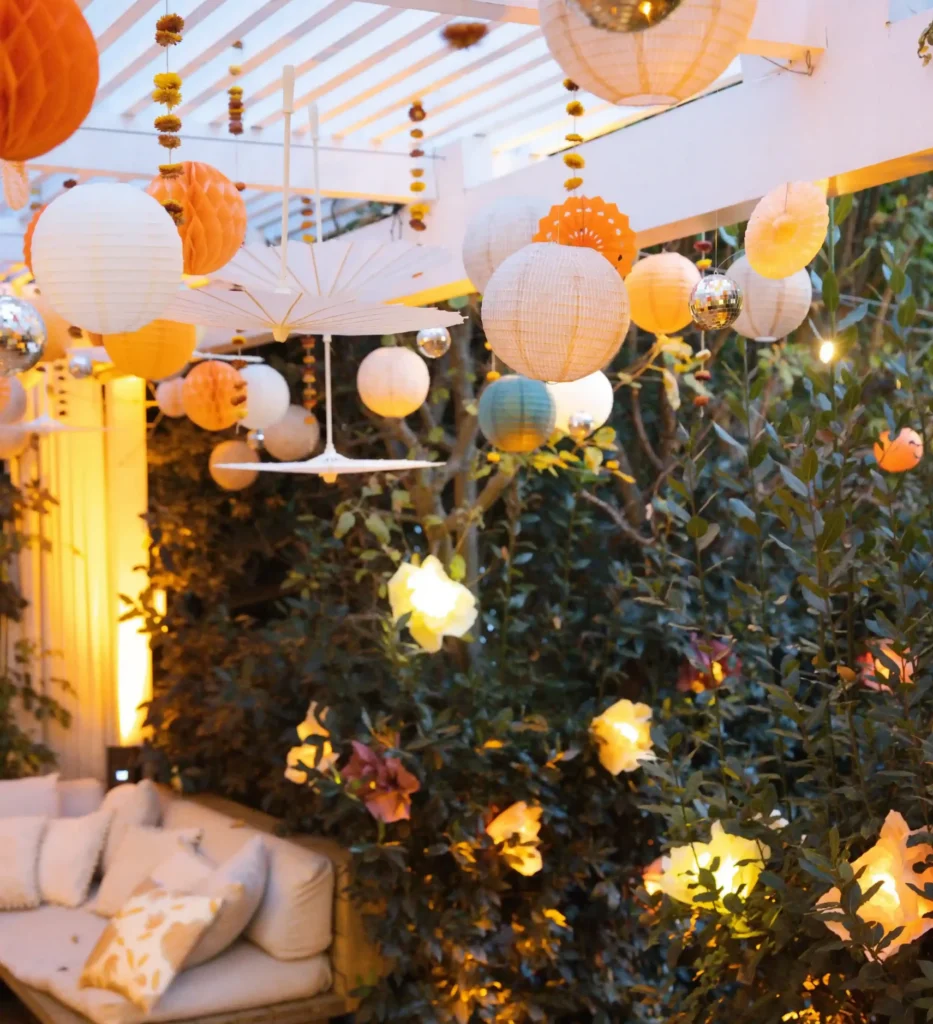
Out came paper lanterns and miniature disco balls, metallic straws and orange paper fans to hold in this heat. Within minutes, I’d made a spectacular mess of the entryway, happily sorting through everything I’d ordered for the occasion.
Except, the funny thing was, there was no occasion.
For months, I’d been wanting to throw a party — simply to have all my friends together. (You see, color is my job, but hosting is my hobby.)
I imagined everyone dancing on the patio, cocktails on the lawn — conversations spilling into the night with no particular reason to end.
But every time I entertained the idea, I found myself looking for a reason to make it happen — a birthday, a holiday. Some occasion that would make the party seem warranted.
Perhaps wanting to bring everyone together was reason enough. So I decided to make an occasion of it anyway.
“Just Because” went from a passing thought to a party theme — (I suppose some habits from the branding department are harder to leave at the office) — and piece by piece, box by box, the evening began to come alive.
The next day, deliveries came and went as I adorned my yard with linen couches, wooden high tops, and fringed umbrellas that would frame the moonlight.
(The absence of sunlight shouldn’t mean the absence of ambience.)
Pockets of seating took shape beneath the citrus tree. Japanese parasols hung from the string lights above the pool. And with every addition, my modest patch of land grew to resemble something of a Garden of Eden.
Never mind that the lanterns were made of paper, that the dance floor was really just my patio, or that half of our paradise had arrived in cardboard boxes. Somehow, once dusk settled over the garden, the familiar corners of my little world felt like somewhere new.
But even with everything in place — decorations catching the breeze, the enormous blood-orange “Just Because!” sign I’d stuck to the garage — I still felt that something was missing.
And then it occurred to me.
“Ah, yes. The balls.”
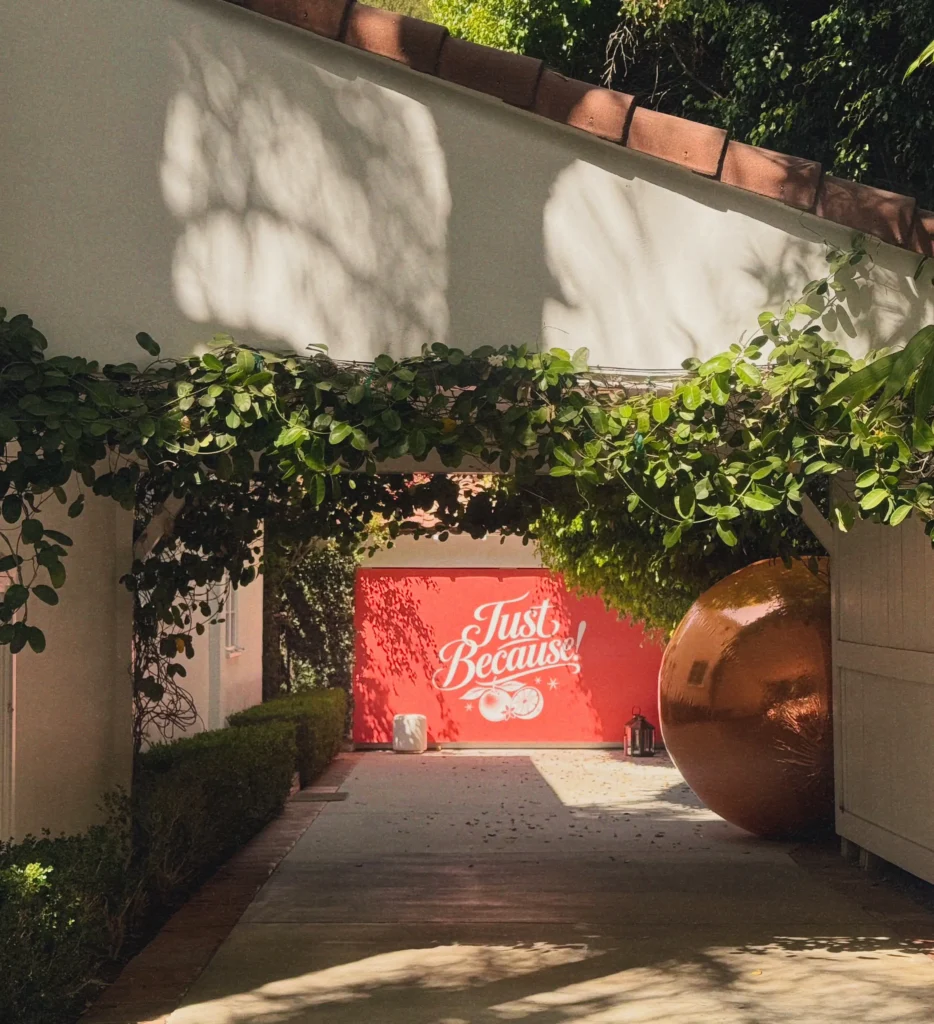
The giant inflatable balls I’d ordered had nearly slipped my mind. I dug them out of the garage and began blowing them up, imagining where each might go. One would sit along the driveway, greeting guests as they wandered to the back of the house. Another would rest on the grass in the corner, while a third would float aimlessly in the pool.
They served absolutely no practical purpose, but I wanted something unexpected amidst the romance of the garden. A little spectacle among all that softness.
Once inflated and arranged around the yard, I realized I’d severely underestimated their size. They didn’t just add drama; they challenged my understanding of scale altogether. And yet, looking at these enormous, utterly ridiculous spheres scattered across the garden, I couldn’t imagine the space without them.
As Saturday’s sun began to set, I put the finishing touches on everything — arranging limes and tangerines around small glass candleholders, tucking sprigs of fresh sage into the gaps.
Still fussing over the fruit, I heard the doorbell and ran to answer it. The door swung open, and there she was — one arm balancing containers of fresh garnishes, the other reaching out for a hug.
“Hello, my dear!” she exclaimed, grinning. (The only thing bigger than her smile was her personality.)
Dahlia is a fixture at my celebrations. Not merely the bartender, but something of a fairy godmother with a cocktail shaker. By now, all my friends have come to know her, along with her famously heavy pours and the lightness she brings to every room.
We made our way to the bar, where she began unloading fresh mint, espresso beans, and her famous homemade margarita mix.
I slipped into the kitchen to grab the “Just Because” cups I’d spent the afternoon washing.
“So tell me, Daniel,” she asked playfully. “It’s not your birthday… Why are we celebrating tonight?”
I placed one of the cups in front of her.
“Just because!” I proclaimed.
A smile spread across Dahlia’s face, the sort that made me feel as though she understood something I’d only just begun to realize myself. Perhaps we’d both been wondering the same thing: why did we always need a reason?
“I like it,” she said with a wink.
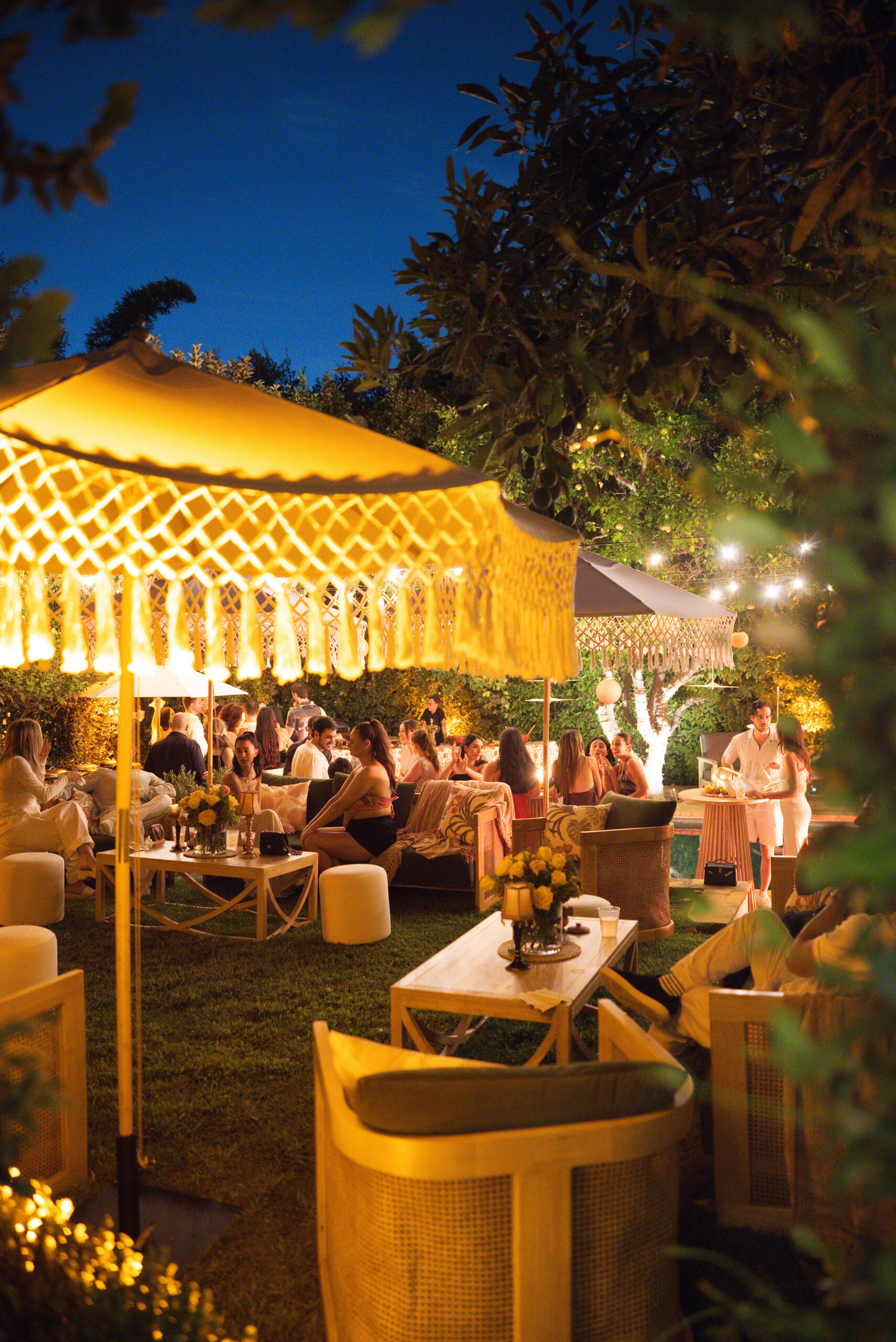
A couple of hours later, friends came with friends, familiar faces introduced me to new ones, and the garden filled with a wonderful kind of commotion. Kisses landed on both cheeks, and conversations overlapped as the music grew louder.
The kind of traffic I adored.
Inside the bar room, guests crowded around the marble countertop — its emerald surface catching the light behind a swirl of silhouettes clinking their cups.
Outside, the umbrellas glowed with amber as the parasols swayed. Even the enormous inflatable spheres, ridiculous as they were, seemed perfectly at home among the guests.
And a few feet away, we danced.
Lauren shook, Elan shimmied. Sydney twisted, Nina twirled. And Safir and I claimed the fire pit.
The evening was far too warm for a fire, so we climbed on top of it.
(Every party needs a B-stage, after all.)
We held onto each other for balance — in some part because of the height, in large part because of the tequila we’d thrown back.
Whitney thundered through the air, fans fluttering to the beat. Some of us on the floor, a couple of us a few feet above. But under the lights, as the sweat began to sparkle, I swear our feet had left the ground.
(Apparently, the Thunderpuss remix of ‘It’s Not Right but It’s Okay’ can induce a state of transcendence.)
As the night stretched into the early hours of the morning, my friends slowly made their way home. There were lingering hugs, promises to get together soon, and the occasional goodbye that took another twenty minutes to finish.
But it was one of the shortest goodbyes that stayed with me.
“I didn’t know how much I needed this,” Nikki said as she left.
(It was a good thing it was too dark to see me blushing.)
Eventually, I found myself walking through Eden alone.
The garden was quiet again, but the evidence of the evening was everywhere: empty cups, confetti, a stray orange fan resting beneath the citrus tree.

One by one, I blew out the candles. The fruit followed me back inside, and the enormous spheres that had seemed so essential only hours earlier were finally deflated (as was I).
Still, I took my time putting everything away.
Back inside, Dahlia was packing up the last of her things.
“Goodbye, my dear,” she said, smiling. “What a beautiful night. Who knew celebrating for no reason could be so much fun?”
I gave her a hug and handed her an envelope.
“Thank you, honey,” she said.
Her shaker tucked beneath her arm, she walked down the driveway, gradually disappearing into the dark. And just as I was about to close the door, I heard her voice calling from the street, followed by a familiar giggle.
“Just because!”
I laughed.
It’s funny how much of our lives we spend looking for reasons — to take a chance, to try something different. Even just to bring people together. At work, at home, even in the smallest corners of our imagination, we find ourselves searching for justification before allowing an idea to bloom.
And I suppose there’s something sensible about that. We can’t go through life doing everything on a whim. There are responsibilities, consequences, and the occasional stockpot that actually needs to sell.
But maybe there’s room for a little more spontaneity, a little more indulgence, and the possibility that something seemingly out of place might be exactly what was missing.
I’d spent weeks arranging a celebration that had no occasion, only to discover how much there was to celebrate. And somewhere in the honey of it all, I was reminded that a life full of color doesn’t always need an explanation.
Because for all our doubts and deliberations, sometimes we have to trust ourselves. Other times, we have to celebrate ourselves. But most times, simply put — we just have to find our balls.